


From the town website, the 2019 Richmond, VT police activity statistics — crimes, traffic tickets, warnings, etc:
How Much Is Your Town Spending On Police?
Stefani Hartsfield shared this link from VTDigger:
How much is your town spending on police? Search UVM/VTDigger’s statewide database
resources about migrant justice
https://migrantjustice.net/immigrant-rights
file:///Users/anngnaumann/Documents/mythsandrealities-%20migrant%20justice.pdf
https://migrantjustice.net/Goodrich-Farm?link_id=5&can_id=587005708a4bbb28435cb4241bb5a815&source=email-i-knew-i-wasnt-alone-workers-picket-abusive-farm&email_referrer=email_737925&email_subject=i-knew-i-wasnt-alone-workers-picket-abusive-farm
Fair & Impartial Policing in Vermont
History & Background:
In response to repeated instance of racial profiling and collaboration between local police and immigration officials, Migrant Justice has been working for many years to implement bias free policing policies in the state. Years of courageous organizing by immigrants and people of color in Vermont resulted in 2016’s robust Fair and Impartial Policing Policy (FIPP) which upheld the principle of equal treatment under the law by protecting all Vermonters from biased policing based on personal characteristics (like race, gender, or sexual orientation) or immigration status and limiting local police from engaging in immigration enforcement.
The 2016 FIPP victory arrived after years of organizing by Migrant Justice to advance a powerful, worker-defined human rights platform. In 2014, farmworkers descended on the State House to win passage of Act 193, which mandated that all police departments in the state implement FIP policies and gave a July 1st, 2016 deadline for departments to adopt the model state policy. The law explicitly named Migrant Justice as an organization that must be at the table developing the anti-discrimination measures, and we have done so alongside our allies at the ACLU, Justice for All, the Human Rights Commission, and the Peace and Justice Center.
The 2016 FIPP was an exemplary policy, creating extensive guidelines to limit police collaboration with deportation agents; however, many departments around the state chose not to fully implement the policy. This prompted Migrant Justice and others to go back to the State House in 2017, passing a law compelling departments to implement the policy in full. Police officials took advantage of this to reopen discussions on the model policy, in an attempt to water it down. Despite the powerful testimony of farmworkers, widespread ally support — as well as footage of Franklin county’s deputy sheriff calling Border Patrol to a routine traffic stop because of blatant racial profiling — on December 12th, 2017 a group of law enforcement officials voted to weaken Vermont’s Fair and Impartial Policing policy, effectively opening the door for increased discrimination and police collaboration with Trump’s deportation agents.
The current statewide VT Fair and Impartial Policing Policy:
The current statewide model FIPP can be found by visiting the Criminal Justice Training Council webpage: https://vcjtc.vermont.gov/content/model-fair-and-impartial-policing-policy
This most recent version of the FIPP was approved by the Vermont Criminal Justice Training Council in December 2017, and is currently being implemented by law enforcement agencies across the state. Although bias free policing policies like this are increasingly important given the Trump administration’s extreme anti-immigrant stance – the 2017 statewide Model FIPP falls short of what community stakeholders have advocated for in several key areas:
- It allows the sharing of confidential information with immigration agents, so long as it’s justified on grounds of “public safety” or “law enforcement needs”
- It evades prohibitions on asking about immigration status by allowing officers to rely on the pretext that the person is suspected of having recently crossed the border
- It allows for the reporting of immigration status of victims and witnesses of crimes to deportation agents
- It grants deportation agents access to individuals in police custody, effectively turning local police stations into temporary holding cells for ICE and Border Patrol
Another of the key differences between the state model policy (less strong) and the Winooski policy (much stronger) is that the Winooski policy has taken out all mention of the federal statute 8 USC 1373. This is the law that Trump has been using to threaten denying federal funding to cities and towns with sanctuary policies that limit the sharing of information between local law enforcement and federal immigration officials. However, it is important to understand that many of the changes we’re calling for with the Winooski policy have little to do with federal statutes and were not even mentioned in a recent letter from the Trump administration questioning Vermont’s policy. Furthermore, in ruling after ruling, courts have sided with states that have implemented policy to protect immigrant rights roundly rejecting Trump’s strategy of using federal funding as a cudgel to force local jurisdictions to comply with his agenda of mass deportation.
Strengthening the FIPP:
Despite the weakening of Vermont’s Fair and Impartial Policing Policy, Migrant Justice is organizing town by town to encourage local governments and police departments to go beyond state requirements and create a firewall between local officers and federal deportation agents.
In March of 2020 Hartford, Vermont finally won a multi-year campaign to enact stronger protections for immigrant community members by strengthening it’s Fair and Impartial Policing Policy (FIPP). Several days later, the town of Norwich followed suit. Across the river in New Hampshire two others towns passed similar policies, and on March 10th 2020, Burlington won a historic victory when the City Council voted 11-1 to close the loopholes in their FIPP. With these groundbreaking victories under our belt, it’s time to use this momentum to organize!
Currently there are four towns in Vermont (as well as two towns in NH) which have taken action to protect immigrant community members and pass stronger versions of the Fair and Impartial Policing Policy. Those towns are Winooski, Hartford, Norwich and Burlington. Winooski was the first town to organize for a stronger policy and you can read the language which they adopted in collaboration with Migrant Justice, the ACLU and other stakeholders. (Check out the Winooski FIPP by visiting: https://winooskipd.files.wordpress.com/2018/03/03-01-18-fip-policy.pdf) Hartford, Norwich and Burlington’s improved FIPPs are also based on the same policy language.
Meeting Tonight: 7/14/2020
The Racial Equity group will meet tonight via Zoom. We will hear from town planner Ravi Venkataraman regarding the new town Housing Committee, discuss any other pending business, and then will split off into breakout rooms.
You may choose which group you want to join during the meeting tonight or let Christine Werneke know and she’ll update this for the group beforehand.
- Policing and Policy – lead(s) are Sean Witters, Cody Quattroci
- Participants: Eveline, Ann Naumann,
- Education, Story Circles – lead(s) are Bonny Steuer
- Participants: Christine W,
- Reparations, Fundraising – lead(s) are Kelsey Welborn
- Participants: Scott Silverstein,
Topic: Richmond Community Racial Equity Group
Time: Jun 30, 2020 07:00 PM Eastern Time (US and Canada)
Every week on Tue, until Aug 11, 2020, 7 occurrence(s)
Jul 14, 2020 07:00 PM
Jul 21, 2020 07:00 PM
Jul 28, 2020 07:00 PM
Aug 4, 2020 07:00 PM
Aug 11, 2020 07:00 PM
Please download and import the following iCalendar (.ics) files to your calendar system.
Join Zoom Meeting
Meeting ID: 864 8989 6358
Password: 241370
One tap mobile
+13126266799,,86489896358#,,,,
+19292056099,,86489896358#,,,,
Meeting ID: 864 8989 6358
Password: 241370
Vermont bookstores see record sales of anti-racism titles
From VTDigger: https://vtdigger.org/2020/07/10/vermont-bookstores-see-record-sales-of-anti-racism-titles/
As the article linked in above relates, Vermont’s 20+ independent bookstores are seeing booming sales of anti-racism titles. It’s heartening to see that there’s such interest and it’s also good, period, for the bookstores themselves. That said, the article didn’t go on to say which independent bookstores are minority-owned; if anyone knows the answer, please pass it on.
Letter to Richmond Selectboard re: Police Chief hiring
The Police and Policy subgroup of the Richmond Racial Equity group spent quite a bit of time this past week discussing the posting of the Richmond Police Chief position by the Richmond Selectboard. In consequence of that discussion, a letter was prepared, modified, commented-on, and ultimately approved and transmitted to the Selectboard members and to the Town Manager. The letter is below; you can grab the PDF version at the link immediately below, or scroll on down to read it here.
Dear Select Board members and Town Manager,
It has come to our attention that the job advertisement for the hiring of a new Chief of Police has already been posted. We respectfully request that this be withdrawn, pending more discussion regarding town needs and priorities.
The request for a pause and discussion is necessitated by the persistent and inevitable issues regarding hiring and retention in Richmond’s police department. Chief Muldoon did a notable and admirable job setting a new tone and implementing meaningful changes, but he is departing after 15 months on the job. Similar issues haunt our retention of officers. We recognize that Select Board members are acutely aware of the problems of turn-over and of the related and significant hiring, start-up and training costs. Further, we appreciate and understand that this presents a challenge to our Town Manager who has worked so thoughtfully on previous hires. We are also aware that much previous work has gone into addressing these issues and that there are many nuances to consider, including shift coverage, staffing assignments, and a range of quite complicated issues for the town and for the administration of public safety and policing in Richmond.
We are asking that the town of Richmond use this transition as an opportunity to do something innovative and to address longstanding problems of retention, staffing, and coordination. We suggest that this is also a means for thinking about the position in a frame that is broader. In a time of deep change, Richmond has the opportunity to be a model for public safety and to follow the path already laid out in previous work by Chief Muldoon, Select Board members, town staff, and citizens.
What if we envisioned an innovative public safety coordinator role to address, manage, and coordinate, not just policing, but mental health services, school outreach, and coordination with fire and rescue? As a town, we are investing in the Community Outreach Program, the School Resource Officer position, the Vermont Youth Project, and recently the healthy, connected community study. Individually, these programs each support an aspect of our community; but when coordinated with the Police Department and town staff, together they can bridge gaps, save resources, and foster innovative community solutions. This seems to be in line with expressed needs of the town and will support our police officers and other town employees by sharing workload and responsibilities in a responsive and responsible manner.
This is a way of responding to the national and state concerns raised by Black Lives Matter, but it is also a chance to enhance public safety, community health and human dignity for all people working, living in, and visiting our town. With all of this in mind, we ask that we pause and have a meaningful discussion about the following: A) what is the actual job for which we are hiring, and B) how we conduct that search.
Sincerely,
Sean A. Witters
Lee Diamond
Connie van Eeghen
Jay Furr
Madeleine Granda
Ann Greenan Naumann
Ashley Hanlon
Stefani Hartsfield
Alexis Lathem
Emily K. Mitchell
Susan Nussbaum
Brittany O’Brien
Brodie O’Brien
Rebecca Rouiller
Scott Silverstein
Rebecca Starks
Kelsey Welborn EMT
Eliza West
Christy Witters
Patty Brushett
Jeff Forward
Cody Quattrocci
July Donating! Black Farmers and Food Producers
Hello Anti-racist friends!
This month, I’ve been enjoying the delicious local VT harvest- strawberries, raspberries, corn etc. etc.. I’ve also been helping my white friends who have houses with their gardens. It’s made me so abundantly grateful that we have access to local fresh produce and that our state is teeming with so many successful small organic farms. And I’m so grateful that our state has such incredibly gorgeous and nutrient-rich farm land! It is truly a privilege. Access to farm land is a privilege. Access to fresh produce is a privilege. Access to a yard to have garden on is a privilege. And it got me thinking about Black farmers and the relationship between Black people and land.
Black property ownership in the country remains low (from USA Today) –
“Among Black families, 44% owned their own home as of the first quarter of this year compared to 73.7% of white families, according to the U.S. Census. And that disparity is even greater depending on the city, according to an analysis of census data by the national real estate brokerage Redfin. Homeownership is critical to the accumulation of wealth and a factor in the stark difference between the net worth of white families, which was $171,000 in 2016, versus Black families who had a net worth of $17,150 according to Brookings Institution.”
Adding to the systemic inequality, “it is well-documented that homes in Black neighborhoods generally appraise for less value than similar properties in predominantly white areas.”
There is a similar story when it comes to Black-owned farm land (from the Equal Justice Initiative) –
“Today, the vast majority of Black farmland in America is owned by white people or corporations. From a million Black farmers in 1914, there were 18,000 in 1992. … The large wealth gap between white and Black families today exists in part because of this historic loss.”
In this country, land ownership means capital and sovereignty. We all know that Black people in this country have been denied housing through red-lining policies for decades, but they have also been disenfranchised by white racist systems that hurt black farmers and food producers.
An incredible podcast “1619” , from the New York Times, does a two-part episode about the loss of black-owned farm land and its devastating effects on Black families- Listen and Learn Here
Taken from Mistinguette Smith of the Black/Land Project, from “By Land, Made Kin”
“People seek to return to ancestral lands, to locate the one place on which they know their people set foot. This seeking is more than just compensation for the conditions of constant displacement that create the condition of blackness. Black Americans—whether they are the descendants of slaves or first-generation Nigerian-Americans—define their connection to land as caring not only for the land but also for the stories of the people who have shared it. Shared tenure begets kinship; the land itself becomes kindred. A place becomes your home because your people are on the land…But there is something in blackness that knows property is a temporary agreement with the government, one easily revoked by the stroke of a pen or a calculating mob of white men with guns. Land, however, is something else. Land is something you know, and it knows you. Centuries of caring for land can bind people together with something stronger than shackles and deeper than freedom. Land, like blood, makes ties that cannot be unbound.”
So–We all know that property and farm land in VT are prohibitively expensive, even for white families. How can we support Black Vermonters in obtaining property and land in this amazing state? I’ve been thinking about supporting Black Vermonters in FOOD SOVEREIGNTY. It’s different than food security. What is Food Sovereignty? “Food Sovereignty”, a “term coined by members of Via Campesina in 1996, asserts that the people who produce, distribute, and consume food should control the mechanisms and policies of food production and distribution.” Aka, how can we support Black Farmers and chefs in Vermont? How can we help them secure land and property such that they can produce food on their own terms for their own communities?
There are two local (Burlington-area) causes I ask us to donate to THIS MONTH, and tell your white friends to donate to as well-
Cafe Mamajuana in Burlington is a Black-woman owned Dominican, African, Spanish and Sicilian fusion restaurant and needs funds to secure a brick-and-mortar location. It would be the first Afro-Latinx restaurant in VT – Donate to Cafe Mamajuana
and
Candace Taylor (Black herbalist, yoga instructor, chef and all-around amazing human) of Conscious Homestead needs some funding to start an BIPOC Urban Farm and Wholeness Center in Winooski. As many of you may know, Winooski is one of the most diverse and poorest towns in the state. This Urban farm would include a learning kitchen, classes, farm stand and mentorship programs. s
Learn more about Candace and buy her medicinal remedies!
Replay: Richmond Racial Equity Group, July 7, 2020
Upcoming Events! July 10th-July 31st
Hello everyone!
Per my promise, I am going to let you know about virtual meetings that are happening this week around whiteness/racism/allyship in VT. It is time to join larger conversations so we can think more critically about work in Richmond.
UPCOMING EVENTS:
Tonight (July 9th) is a virtual presentation from Mark Hughes of the Vermont Racial Justice Alliance on the push to have reparations legislation passed in the state government. From 6pm to 8pm. They are asking for a small fee to attend the event. Below is a link to the event! You must have access to Facebook to access the Zoom link to the meeting!
https://www.facebook.com/events/1283795111820645
Here is the description:
“The Legislative Series continues. Created to provide a forum to educate community members and gain their perspectives while informing legislator’s decisions on policy, the Series was running throughout the legislative session and all forums were being conducted at the Statehouse until the COVID-19 outbreak. Now, we’re bringing it to your living room.
We’re offsetting some of our expenses with a nominal fee. EVERYBODY can attend this event. For free access send a note to info@justiceforallvt.org
If you’d like to give more, go here after registration:
https://vtracialjusticealliance.wordpress.com/support/
The deliberations in the US House of Representatives on legislation that would create a Commission to study and develop reparations proposals (HR.40) have reached a fever pitch. A bill has been introduced in Vermont that would establish a task force to study and consider a State apology and proposal for reparations for the institution of slavery. Vermont law makers remain SILENT on the matter, despite the national racial unrest. We’re advancing the discussion. Is the appointment of a task force to examine an apology and reparations the appropriate solution? What are the hopes and fears of community and policy makers surrounding the prospect of such task force? There is allot to discuss and we’ll bring representatives from community, policy makers, clergy and activists together for that discussion.”
https://vtracialjusticealliance.wordpress.com/support/
The deliberations in the US House of Representatives on legislation that would create a Commission to study and develop reparations proposals (HR.40) have reached a fever pitch. A bill has been introduced in Vermont that would establish a task force to study and consider a State apology and proposal for reparations for the institution of slavery. Vermont law makers remain SILENT on the matter, despite the national racial unrest. We’re advancing the discussion. Is the appointment of a task force to examine an apology and reparations the appropriate solution? What are the hopes and fears of community and policy makers surrounding the prospect of such task force? There is allot to discuss and we’ll bring representatives from community, policy makers, clergy and activists together for that discussion.”
Again, if you want help making a FB page or accessing these zoom discussions, let me know!
The Vermont Racial Justice Alliance is offering another Zoom panel this month:
“Hidden in Plain Sight: the Truth about Systemic Racism” on July 16th at 6pm
The Peace and Justice Center is offering some zoom discussions and panels this month as well:
“Prospective Facilitator Gathering” on July 17th on 5:30pm
“Toxic Whiteness Discussion Group” on July 22nd at 5pm
In-person EVENT(s):
The Frederick H. Tuttle Middle School in South Burlington SOAR group (Students Organizing Against Racism) will be doing peaceful vigils along Dorset Street every Wednesday until mid-August from 4:00-6:00 pm. They invite the public to join. Bring signs!
Pop-Up Chicken BBQ and Back-to-School Fundraiser on Sunday July 12th
Time: 2 pm
Location: Battery Park, Burlington
Description:
“Get your family some tasty BBQ and delicious treats this Sunday, at the Holiday Inn Burlington, 1068 Williston Rd!
Black Lives Matter of Greater Burlington and People’s Kitchen are hosting a Pop-up Chicken BBQ fundraiser to help our brother Otis Clemmons’ family with their school supplies.
Our volunteers will be serving BBQ Chicken in People’s Kitchen sweet-spicy-tangy marinade served with sides choices of Alabama-style baked beans, mustard greens, coleslaw, a warm roll and of course, our famous peanut sauce. Hot dogs with fixins’ also available for the kids, as are vegan BBQ options of grilled tofu, tempeh and young jackfruits.
Sliding scale $5 – $20 a plate donation suggested, cash or venmo @peopleskitchenvt. All food are not only gluten-free, Halal and tasty, but also prepared, cooked and served with lots of LOVE by our crew of kitchen ninjas. All proceeds to benefit back-to-school expenses for Otis Clemmons’ family and support People’s Kitchen and BLMGB’s mission to serve our people.”
https://www.facebook.com/events/969267003486198
Here is the actual info about the migrant worker who died of Covid after being deported from VT
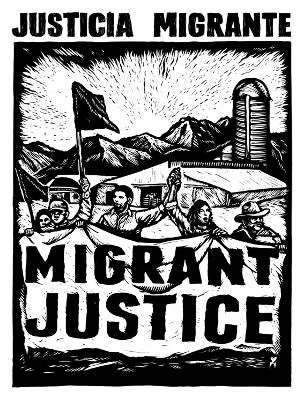
Durvi Martinez, ¡Presente!
Posted Tue, 07/07/2020 – 12:07pm
Migrant Justice leader Durvi Martinez died on July 1st from COVID-19. Durvi contracted coronavirus soon after being deported from Vermont to Mexico. Durvi, a trans woman who had suffered severe violence before immigrating to the United States, was deported despite a pending asylum claim.
Before being deported, Durvi was part of the farmworker community in Vermont and a member of Migrant Justice. They were a brave and outspoken advocate for immigrant and LGBTQ rights. Durvi will be remembered as a loving and supportive friend.
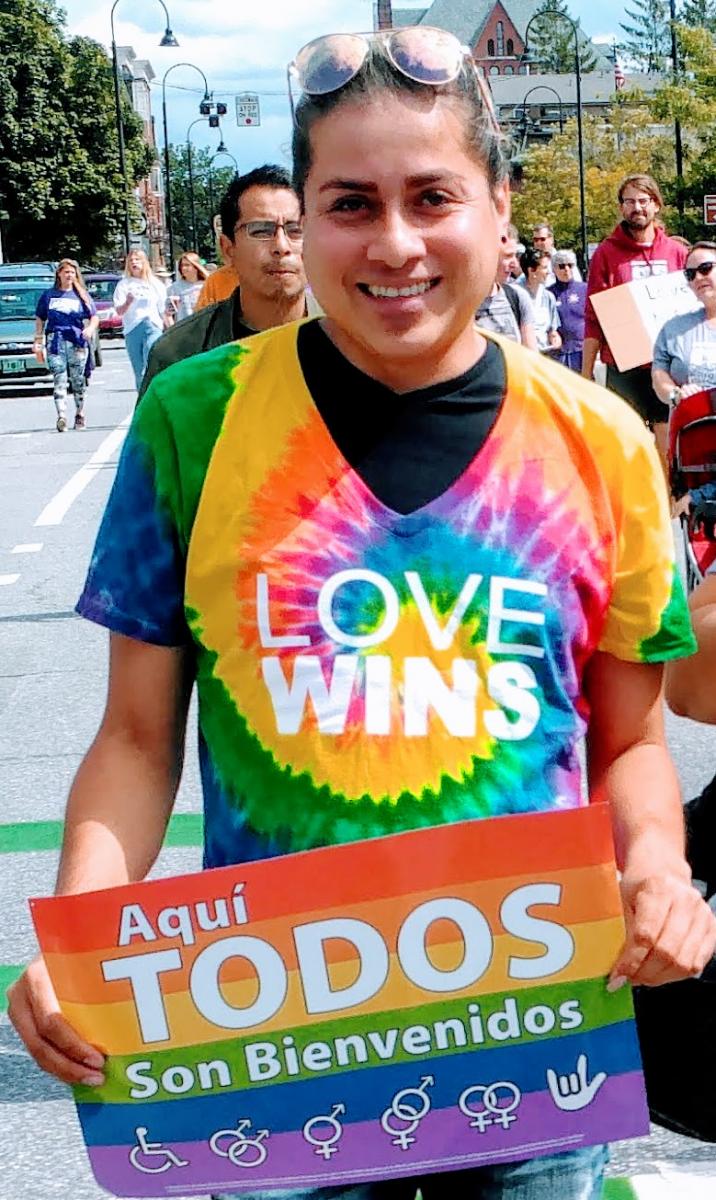
Durvi marching in the 2019 Burlington, VT Pride Parade
Durvi was arrested by ICE in January, 2020 and spent three months detained in deplorable conditions. They were held in an all-male section of the prison, denied medication, and suffered severe weight loss. Durvi’s months in detention led to a weakened immune system that likely increased their susceptibility to the virus that ultimately took their life.
Durvi was in the midst of preparing an asylum application based on the horrific and systemic violence that they experienced as a trans person in Mexico. When the coronavirus pandemic began spreading in immigration detention centers in March, ICE chose to quickly deport Durvi, ignoring the asylum claim and failing to notify Durvi’s lawyer. Rather than releasing Durvi, ICE deported them to their death.
Migrant Justice unequivocally denounces Durvi’s unjust detention and deportation; we hold Immigration and Customs Enforcement responsible for their death.